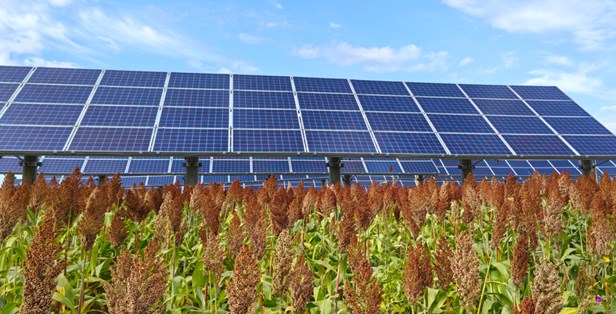
Solar cells are a type of photoelectric semiconductor sheet that uses sunlight to generate electricity directly. They are also called "solar chips" or "photocells". As long as they are illuminated by light that meets certain illumination conditions, they can instantly output voltage and generate current in the presence of a circuit. In physics, it is called solar photovoltaic (PV), or photovoltaic for short.
Solar cells are devices that directly convert light energy into electrical energy through the photoelectric effect or photochemical effect. Crystalline silicon solar cells that work with the photovoltaic effect are the mainstream, while thin-film cells that work with the photochemical effect are still in their infancy.
As of January 2024, China's global patent applications for solar cells were 126,400, ranking first in the world.
Principle of solar power generation:
Sunlight shines on the semiconductor p-n junction to form new hole-electron pairs. Under the action of the built-in electric field of the p-n junction, photogenerated holes flow to the p region and photogenerated electrons flow to the n region. When the circuit is connected, current is generated. This is the working principle of photovoltaic effect solar cells.
There are two ways of solar power generation, one is the light-heat-electricity conversion method, and the other is the direct light-electricity conversion method.
Simply put, the principle of solar photovoltaic power generation is to use solar cells to absorb sunlight with a wavelength of 0.4μm to 1.1μm (for silicon crystals) and directly convert light energy into electrical energy output.
Since the electricity generated by solar cells is direct current, if you need to provide power to household appliances or various electrical appliances, you need to install a direct/alternating current converter to convert it to alternating current before you can supply power to household or industrial electricity.
Development of solar cell charging Solar cells are used in consumer products, and most of them have charging problems. In the past, the general charging object used nickel-metal hydride or nickel-cadmium dry batteries, but nickel-metal hydride dry batteries cannot withstand high temperatures, and nickel-cadmium dry batteries have environmental pollution problems. Supercapacitors are developing rapidly, with super large capacity, smaller area, and low price. Therefore, some solar products have begun to use supercapacitors as charging objects, thereby improving many problems of solar charging:
1. Faster charging.
2. More than 5 times longer life.
3. The charging temperature range is wider.
4. Reduce the amount of solar cells used (low voltage charging is possible).